Check out what we're working on.
Latest newsletter and best LinkedIn posts.
Newsletter issues and LinkedIn posts
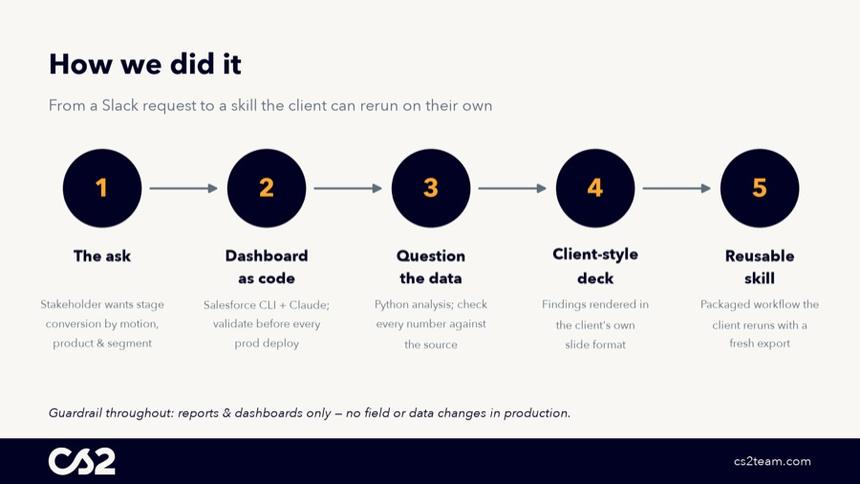
Delivering an SFDC dashboard and actionable insights in a fraction of the time with AI
We brought the structured data and our reporting expertise, and Claude did the heavy lifting.
Nov 13, 2026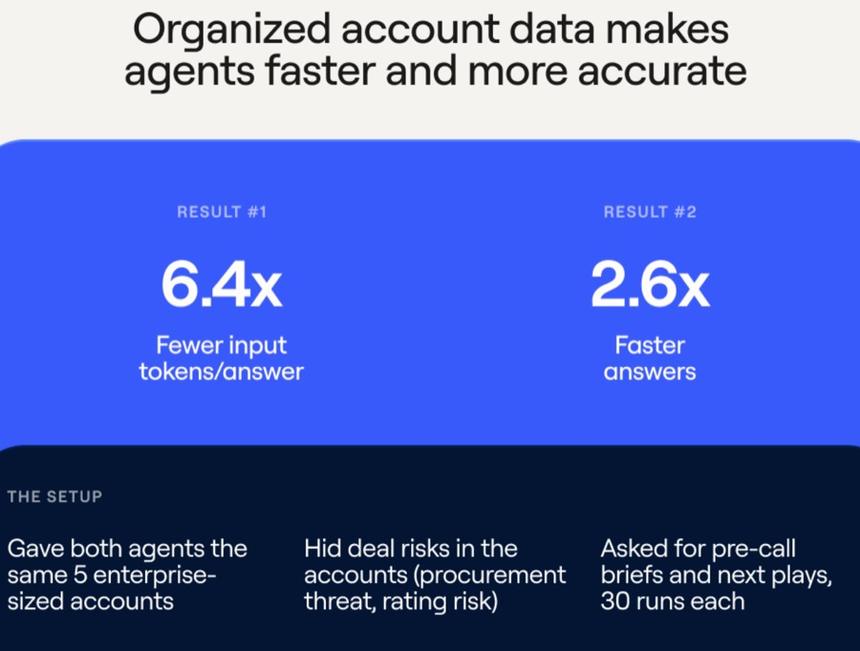
New Lessons from the GTM AI Frontier
What AI forward GTM leaders and teams are learning
Nov 6, 2026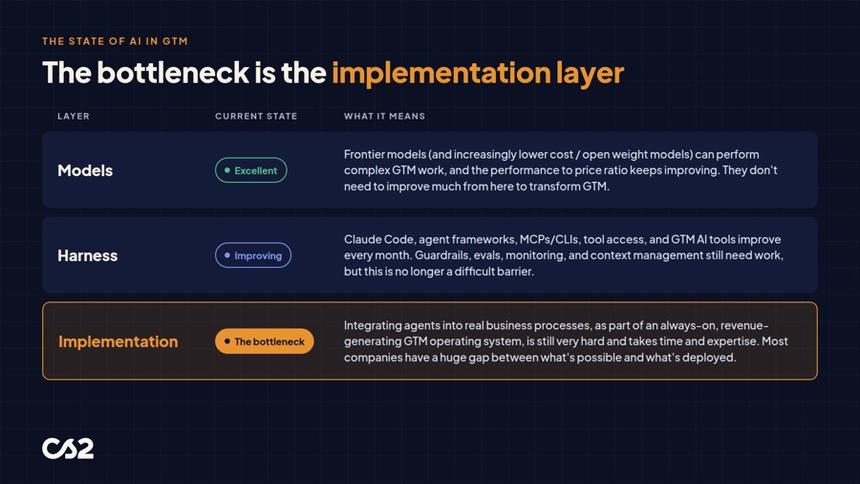
The gap between what agents are capable of vs. what you’ve actually deployed
Most companies are far from the frontier in what the models and harnesses are capable of.
Oct 30, 2026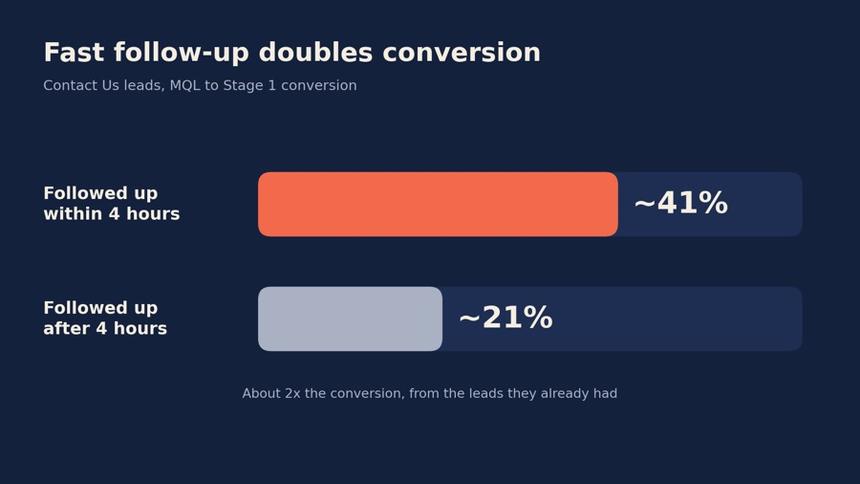
How CS2 created a pipeline goal model & weekly review process an enterprise GTM team could trust
Precision goal creation and weekly actionable insights - powered by AI
Oct 23, 2026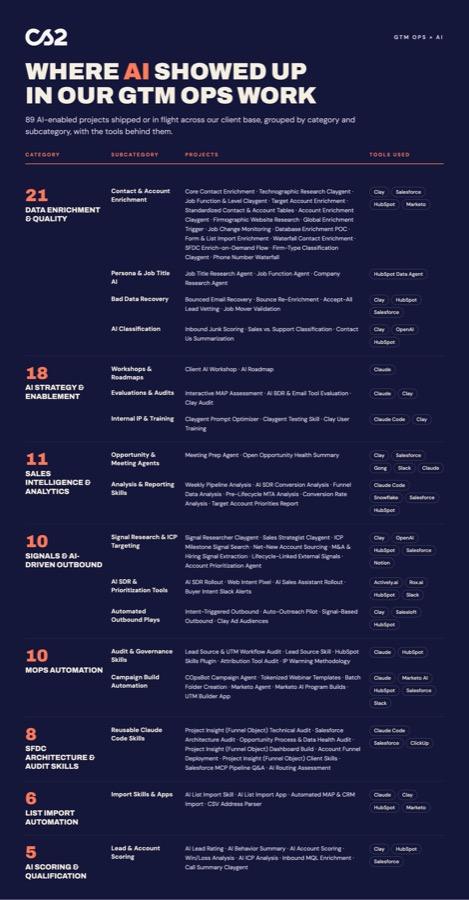
The GTM AI projects we are shipping for clients
Some roadmap inspo for you, perhaps?
Oct 16, 2026
Chatting with people at Clay Sculpt, I realized there are 2 types of gtm engineer: 1. Sales/sdr or non-ops background, got into Clay/AI tools and mainly does outbound, pretty siloed from the rest of the GTM tech stack and data, building a system but it's not tied to the existing gtm system as they don't have the Ops background. 2. GTMOps/MOps/RevOps background, leaning heavily into AI (and the latest GTM tools like Clay) and applying it to the GTM system as a whole, building agents for GTM teams embedded deep into the existing system/infrstructure and tying it to outcomes in those systems (e.g. pipeline, conversions, etc) There are also software engineering background people, but I am seeing that a bit less (could change). Clay tables for outbound not tied into anything may provide some short term value and it's how GTME got started but IMO I'm betting that #2 (GTMOps/MOps/RevOps background) is the way the role needs to evolve, as the whole GTM operating system needs to be "engineered," not just one siloed use case. This is why our GTME team at CS2 all has Ops backgrounds and as we hire more into it I expect that to stay true
164 reactions62 commentsRead on LinkedIn
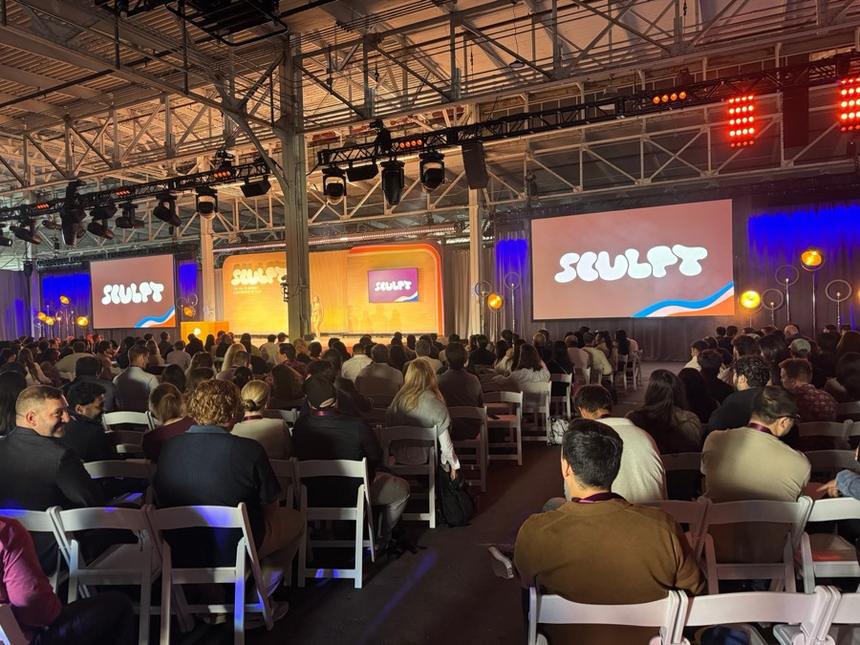
What I’m taking back from Clay’s Sculpt conference that isn’t swag
A fresh next-day recap for ya!
Oct 9, 2026
Over the past 11 years since starting CS2 I have never been more bullish on a GTM product as I have been with Clay. And honestly, it's also been our best partnership experience as well. That is why I am so happy and proud that in just 9 months we have gone from an official partner to winning their Studio Partner of the Year award yesterday! It has been a great experience to bring amazing clients of all sizes, including some big enterprise names to Clay and bring the power of Clay to those clients so they experience more growth and achieve things operating teams never knew they could do at scale or at all until Clay. And we would not have won the award without the amazing work of the rest of the 𝘦𝘯𝘵𝘪𝘳𝘦 CS2 team, but especially Xander Broeffle, who has been leading the charge on our implementation frameworks, pushing for new feature adoption with existing clients, and delivering product feedback to Clay. Also shout out to Christie Montague Fusco, who was an early adopter on Clay and has been pushing it's boundaries since day 1. And Sarah Neal, who led the charge on CRM integration and data from the solutions architecture team. And big big thank you to Tyler Swanson, who was a true partner to us when we kicked off and Amy Reams and Rani Patel who have taken over and made us feel heard and appreciated. And lastly, kudos to Varun Anand and Kareem Amin for creating a great product and ecosystem. We are just getting started! 💪
129 reactions30 commentsRead on LinkedIn

An Inside Look at Our 2026 Team Offsite
AI use cases, building in teams, and a little bit of laser tag and outdoor fun.
Oct 2, 2026
The mistake GTM Teams are making with AI is very familiar…
A tale as old as time.
Sep 18, 2026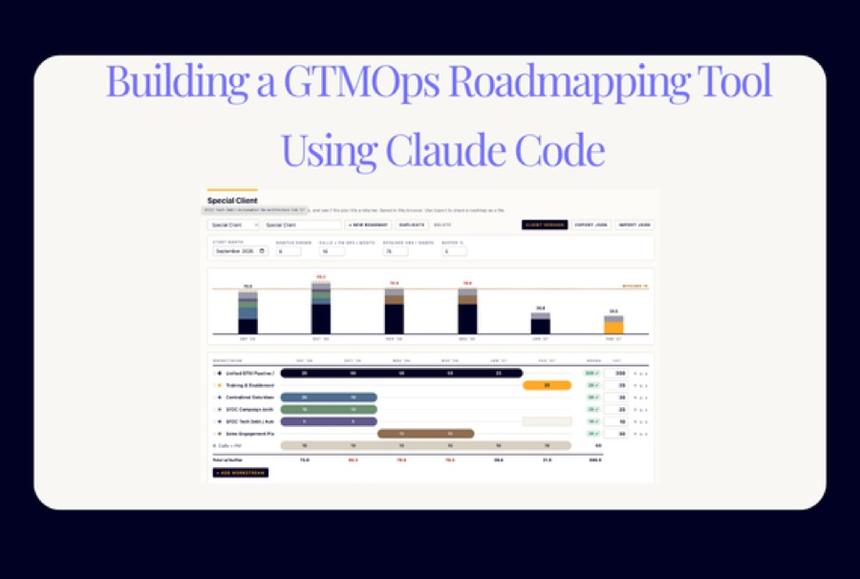
Why you need to copy our GTMOps roadmapping tool
Get the insiders look at how you can build a tool that can protect your team’s time, set boundaries, and even ask for more resources.
Sep 11, 2026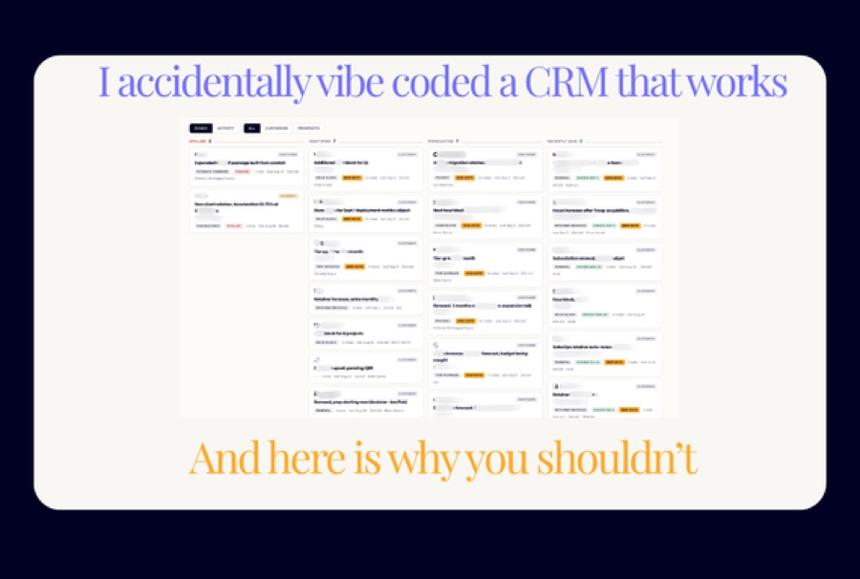
I accidentally vibe coded a CRM that works
Here is why I still think you shouldn't, but what you can learn from it
Sep 4, 2026
GTM Ops lessons I have learned the hard way, so you don’t have to.
16 years of experience summed up into 16 valuable lessons.
Aug 28, 2026Building anything agentic in GTM is 90% data work and 10% AI/agent work I've been building a tool for CS2 to manage client health. It tracks across all our clients how things are going (across several different data sources), if there are churn risks, and opportunities for growth. We tried to use a simple Notion agent with simple instructions: here are all our data sources, have at it. But that didn't work. So instead, I built it piece by piece using Claude Code (see image), and almost all my time went to: how to integrate the data, figuring out the data model / data tables, and building the data pipeline. Working through things like: • Call analysis: how to process each call, how to structure the call analysis output data (sentiment as individual records w/ quotes), managing dupe calls where two recorders joined the call, etc) • SFDC contract data: how to surface that in the dashboard based on the data being captured in SFDC • Tracking the client stakeholders: we only have who was invited to the calls (not who actually attended) so tracking who spoke to figure out engagement, enriching the data with Clay to understand the roles, builing a contacts data table. • How all these tables get built and relate to each other to easily generate the dashboard deterministically. It's all data work with the help of AI to build. Then when it runs each week it's still 90% data work/scripts to pull data/etc then 10% Claude reasoning over unstructured data and building summaries. This was no where near a one shot "build me this" and it was done. It was hard work building and figuring out each piece of the data step by step to get a finished product This is why it's so important to have high-quality GTM data before you start building. Because if you have to fix all of your data problems before you start building agents on top, it's going to take 10x longer.
58 reactions14 commentsRead on LinkedIn
I had the wrong measurement of success for myself
And maybe you do too.
Aug 21, 2026
The rise against AI content is here
Don't say we didn't call this.
Aug 14, 2026
Can agents run (most of) your sales pipeline generation?
We measured it, and it’s pretty interesting.
Jul 31, 2026Curious how all the vibe coded CRMs built in January are doing now... My guess less than 1% are still in prod There is no free lunch. What you save in SaaS cost you pay for in salary cost. Likely way more expensive to vibe code your CRM when you factor in inflated token cost, hosting, team salaries to maintain, team salaries to build/optimize, opportunity cost Image source: @Lukebonnici1
180 reactions100 commentsRead on LinkedIn
I identified 5 AI projects for a client in 20 mins
Here is how AND what they are.
Jul 24, 2026
The Summer of Clay
A note on how Clay is rapidly shipping features & inside details on our partnership!
Jul 17, 2026Operators are truly sculptors at heart. They love customization and creating things is their passion. It's why, from the moment I saw Clay I knew they had something special. I instantly signed up for a trial and just over two years ago I posted a video to YouTube titled "Using Clay for AI Sales Outbound" that has since garnered 3.7k views! (most videos only get hundreds for reference) After that, I was all on the case to learn more and suggest it to clients. At the time, I saw it as more of an outbound and enrichment tool. But it is so much more. And the name Clay is so fitting. Because you can mold it to do so many things for the whole GTM team. And our whole team loves that and has been able to do some amazing things with Clay for our clients. Shout out to Christie Montague Fusco Sarah Neal and Xander Broeffle who were the early adopters for our team along with Charlie Saunders and I. But I would say 2026 has been the best year for Clay as well as our relationship with Clay. In January 2026, we officially started the partnership process with Clay led by Tyler Swanson which is a much more intense process than other companies. (Certifications, referrals from clients, weekly calls, working directly with the sales team etc) And I like that. It means when they have a partner they reallly do partner with them. And on the product front - Clay has been just shipping so many amazing things month after month. With features that truly help GTM teams like Audience, Ads in Clay, Governance features, an MCP/API/CLI etc. We are excited that today we were announced as Clay's newest Studio Partner! It is truly a signal of our feelings about the trajectory of Clay and what value it can bring. So if you are a sculptor at heart and want to learn more about what you can do with Clay for your GTM team feel free to reach out. And thank you, Clay, for this great recognition. Working with your team has been awesome. 🎉
77 reactions18 commentsRead on LinkedIn
Something we’ve been cooking up for a while: CS2 is a Clay Studio partner. When Clay exploded onto the scene 2-3 years ago, it was obvious they hit a sweet spot. Operators were granted new powers to build whatever they could dream up while not held back by existing frameworks baked into their current GTM tech. But back then, most of the use cases dominating Linkedin were focused on outbound and somewhat siloed from the rest of the tech stack and data. Outbound is a great use case, but the more we used Clay with our type of clients (growth/scale up tech/ai/saas), we realized it was much more than that. So early on, we decided to build out Clay as core GTM infrastructure. Powering all GTM motions, orchestrating and governing data quality across the full customer lifecycle, and as one of the best-positioned tools to host agents. And we’ve kept on doubling down as Clay has innovated and developed into one of the key tools we implement for clients: • We created our own GTME practice to lead on all things AI and the next generation of GTM tech (Clay included) • Started regularly engaging with the Clay team (thanks Tyler Swanson, Lindsay Workman, Nancy Mottice!) • Started training our other practice areas on Clay so they can build in Clay and/or integrate Clay into the systems/data they specialize in (CRMs, MAPs, other automation/data/AI tools, BI, sales engagement, etc) • Dozens of builds in Clay operating as foundational infrastructure integrated into the rest of the stack (e.g. full CRM/MAP database enrichment, custom signal capture, account-based prioritization, sales enablement, account buying unit mapping, deep account research, sales prep, sales call analysis, etc) • Worked with Clay and some of our clients on multi-6-figure Clay contracts to make Clay a foundation for their GTM It’s been fun to see this all develop, and meanwhile, Clay’s still been killing it with new releases: • Functions • Audiences • Clay MCP • And just this week, the CLI to build in Clay (very excited about this one) We’re always quite considered when it comes to the tech we develop strong partnerships with, but Clay has been an obvious one from the beginning. So we’re stoked to announce this and to get back to work building
93 reactions36 commentsRead on LinkedIn
The one thing that is driving B2B buying behavior & satisfaction
And how some AI companies are thriving because of it.
Jul 10, 2026
We are living in an AI world, not an AI bubble.
Plus, an updated list on our top AI use cases we are working on for client.
Jul 3, 2026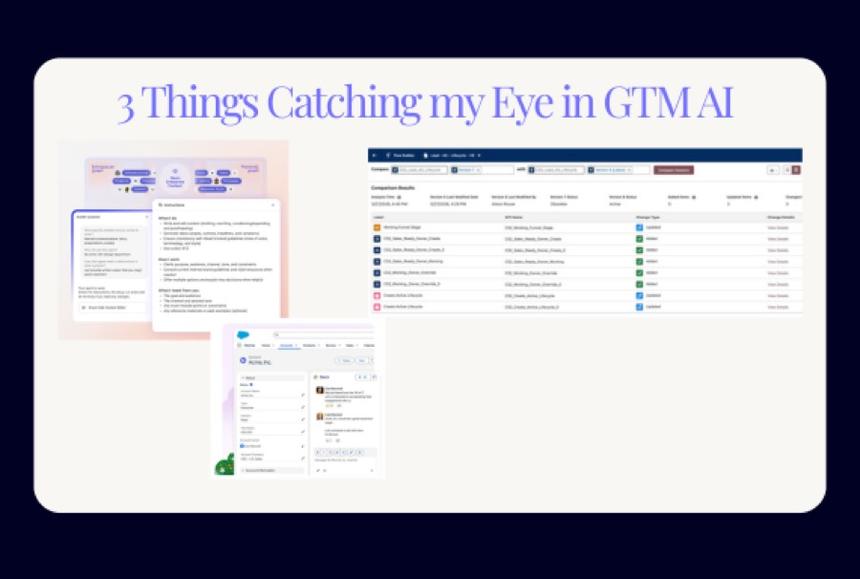
3 Things Catching My Eye in GTM AI
Plus, an exciting announcement from CS2!
Jun 12, 2026
Instead of looking for AI projects internally, go find pain points or needs.
Advice for getting GTM AI projects on your roadmap so you can get your "reps" in!
Jun 5, 2026Polsia ("AI Slop" spelled backward) raised $30m with one employee + AI. Legit? ZoomInfo going headless with GTM.AI, stock still down 90%, will the bet pay off? Do GTM Tools need a UI or is headless the way? Clay is building more stuff for their complex customers / enterprise. Is Marketo waking up from a decade long nap? I sat down on the podcast with Crissy and Xander (leader of our GTM engineering practice), to talk through the latest moves in GTM. Here are the notes: (1) ZoomInfo's bet on going headless w/ GTM.ai GTM.AI is free to start, usage based, and can be called from Claude Code. Seems interesting and is a mandatory move for Zoominfo. Their data is good, but is it better than waterfalling 5 other vendors? tbd if it will pay off in the long run. (2) The UI debate is not settled. Headless is great for: level 2 AI, human+AI working on tasks, or Level 4 autonomous AI agents. For always-on workflow/automation that leverages AI in steps/nodes (level 3), you may still want a screen to log into (for company-wide governance, building, testing, QA, monitoring, etc) (3) Clay's latest features. A while back, Clay used to be more of an indie hacker tool, and every build was a custom table you cloned seven times and hoped would work. Now with reusable Claygents with version control, Functions, Ad audiences, etc., it's more and more a scalable platform for larger, more complex customers. (4) "What can you kill if you buy Clay?" Every new Clay conversation we're having with clients now starts with what to cut. ABM platforms are first cut. It's a full-on consolidation play now. (5) Clay's pricing change. Some people were frustrated, and we understand why, but we can see Clay's side as well. Lots of people were building workarounds to get an artificially low cost. Adding Actions into the consumption pricing will be a transition and may cause some churn, but probably doesn't change the value/cost calculus too much. Will report back when more clients transition to new pricing. (6) Marketo back from the dead? Marketo did not touch its UI for 10 years. Turns out the broken clock was right, now everyone is headless. Their new MCP lets you build agentically, which is what the market is asking for. But tbd if they can pull it off and turn the overall sentiment positive. Episode links in the comments.
41 reactions30 commentsRead on LinkedIn
For all AI/agent builders in GTM it's time to take these 8 things seriously: (1) Agent governance: could your agent send your APIs keys to anyone on the internet (like in the image below)? Do you even know what your AI SDR agent is saying to prospects? Did you give your agent both read and WRITE permissions? (2) Security: Claude Mythos will probably be able to hack your vibe coded CRM. Can someone prompt inject your agent to send your latest list of customers to them? (3) Permissioning: Who on your team has connected Claude to SFDC via MCP? What data does your agent have access to? Can anyone find sensitive data using AI search in your systems? (4) Guardrails: is your probabilistic Skill too vague and could cause damage? Who's monitoring all the new automations? (5) PII: how much PII are you leaking into models? You going to get a GDPR bill sometime soon? (6) Token costs: how are you tracking token costs? What limits do you have? Can one person create an accidental $100k bill at the end of the month? (7) Tech debt: how complicated are the things that you're building right now? Who is maintaining and monitoring them? (8) Data foundation: is your data a mess and therefore going to corrupt any agent on top of it? All these things have been important but right now they're more important than ever as the cost of mistakes gets higher and higher. We're still in the wild west innings with AI GTM, but people are going to get fired over mistakes here And there's going to be whole new categories of jobs created around this stuff
120 reactions20 commentsRead on LinkedIn
RIP Salesforce API Limits 🙃 A lot of non-technical GTM people connecting Claude Code and SFDC are going to get a fun lesson in API Limits PSA: • SFDC has API Limits • Go check what your 24 hour limit is and check how close you are to the limit (Setup > Company Information > API Requests Last 24 Hours) • Set up notifications when API limits are nearing the threshold • Tread carefully before asking Claude to pull data on all your Opps, or update all your Accounts, or pull and analyze a load of data, or anything really, etc • And tread VERY carefully before you do any --dangerously-skip-permissions / agentic processes connected to sfdc If you hit your limit, ALL your SFDC integrations will stop (your marketing automation platform, your sales engagement tool, your BI tool, etc) Fun times playing with Claude until you make your complete GTM system freeze
465 reactions68 commentsRead on LinkedIn
4 things in GTM Ops that seem wildly manual if you still do them the old non-AI way: (1) SFDC automation auditing Old way: click into every flow to review what it’s doing and document. New way: connect Claude Code to SFDC, pull down the metadata, get AI to review and summarize. (2) Running 20 pivots of data to analyze and share Old way: painstakingly build 20 reports in SFDC, adding filters/columns/charts, screenshot and add to deck New way: push data into Claude Code, give the right context, ask for the pivots, it writes python code to produce data and charts, creates deck (3) Mass data updates/adjustments or event list imports Old way: get csv, review data/filter columns, write formulas, update columns manually by hand, add columns, etc New way: leverage pre-built skill that uses deterministic scripts to update data and AI to reason across data to update columns that simple logic can’t handle (4) Mass testing of Hubspot/Marketo forms and triggered processes Old way: someone on the team has to click through and fill out 100 web forms and hates their life while doing it, then manually reviews the activity log. New way: Claude Code with agent-browser (or equivalent) handed list of URLs, Claude Code leverages agent-browser to navigate to each URL, review the form, and fill it out for you. Download activity log and Claude Code reviews what triggered and when and compares to expected outcomes and builds Sheet with pass/fail. There are loads more. What else seems so old skool already for GTM ops?
37 reactions18 commentsRead on LinkedIn
If you are not mining Job Postings you should have a bit of FOMO They have to be the richest source of GTM signals available. You get a peek behind the curtain of: • Tech stack • Team size • Priorities • Current initiatives • Why they are hiring • Team structure and buying unit dynamics And even better: you often get a company literally saying they are about to try and buy your tool, service, or software. Surely there is not a GTM signal on earth better at finding companies in market than a company saying "we are going to buy XYZ"?!?! A client of ours sells CLM and we're finding the examples in the screenshots: "𝘴𝘦𝘭𝘦𝘤𝘵𝘪𝘰𝘯 𝘢𝘯𝘥 𝘪𝘮𝘱𝘭𝘦𝘮𝘦𝘯𝘵𝘢𝘵𝘪𝘰𝘯 𝘰𝘧 𝘵𝘩𝘦 𝘤𝘰𝘮𝘱𝘢𝘯𝘺'𝘴 𝘧𝘪𝘳𝘴𝘵 𝘊𝘰𝘯𝘵𝘳𝘢𝘤𝘵 𝘓𝘪𝘧𝘦𝘤𝘺𝘤𝘭𝘦 𝘔𝘢𝘯𝘢𝘨𝘦𝘮𝘦𝘯𝘵 (𝘊𝘓𝘔) 𝘴𝘺𝘴𝘵𝘦𝘮 𝘢𝘯𝘥 𝘰𝘵𝘩𝘦𝘳 𝘵𝘦𝘤𝘩𝘯𝘰𝘭𝘰𝘨𝘺-𝘥𝘳𝘪𝘷𝘦𝘯 𝘪𝘮𝘱𝘳𝘰𝘷𝘦𝘮𝘦𝘯𝘵𝘴" "𝘩𝘦𝘭𝘱𝘪𝘯𝘨 𝘵𝘰 𝘱𝘳𝘰𝘤𝘶𝘳𝘦, 𝘪𝘮𝘱𝘭𝘦𝘮𝘦𝘯𝘵 𝘢𝘯𝘥 𝘴𝘤𝘢𝘭𝘦 𝘢 𝘤𝘰𝘯𝘵𝘳𝘢𝘤𝘵 𝘭𝘪𝘧𝘦𝘤𝘺𝘤𝘭𝘦 𝘮𝘢𝘯𝘢𝘨𝘦𝘮𝘦𝘯𝘵 (𝘊𝘓𝘔) 𝘴𝘺𝘴𝘵𝘦𝘮" "𝘦𝘷𝘢𝘭𝘶𝘢𝘵𝘦, 𝘴𝘦𝘭𝘦𝘤𝘵, 𝘢𝘯𝘥 𝘰𝘷𝘦𝘳𝘴𝘦𝘦 𝘥𝘦𝘱𝘭𝘰𝘺𝘮𝘦𝘯𝘵 𝘰𝘧 𝘤𝘰𝘯𝘵𝘳𝘢𝘤𝘵 𝘭𝘪𝘧𝘦𝘤𝘺𝘤𝘭𝘦 𝘮𝘢𝘯𝘢𝘨𝘦𝘮𝘦𝘯𝘵 (𝘊𝘓𝘔) 𝘱𝘭𝘢𝘵𝘧𝘰𝘳𝘮𝘴" We're using Clay to find the postings > AI to analyze the description and extract the signals > Clay to push this into a custom Signal object in SFDC > then Actively AI uses this in its Account-Model for prioritization and sales email copywriting. Job postings used to be a signal that tells you a company is hiring and that is it. But layer on AI and you can extract gold from the unstructured data. Probably one of the quickest ROI things you can build that leverages AI right now
43 reactions15 commentsRead on LinkedIn
Last Monday we celebrated the 11th anniversary of CS2 🤯 And as our name suggests, we didn't really plan to build an agency butut we did. And our small-ish but mighty team has been changing the way companies leverage GTM Ops to see massive improvements in efficiency and revenue growth. To celebrate, I pulled back the curtain and told the story of our journey as how we "accidentally" built an agency. Check out Cooking Up GTM's latest post to go down memory lane with me.
55 reactions16 commentsRead on LinkedIn
Managing usage limits is definitely a new GTM Ops skill we are all learning. Most of the usage constraints we have had in tools before were all tied to thresholds that could easily be managed and usually the vendor gives you some level of leeway with it. Marketable contacts Seats/ Licenses # of workflows etc. But when it's based on credits, tokens, or API calls that can be used in different quantities based on certain actions (ie Clay, Hubspot AI features, SFDC integrations/connected apps) it can cause "usage anxiety." Very similar to EV range anxiety, but you are just always worried about if you have enough and if you will just randomly use too much based on actions you didn't know would / could run or people pulling from the same "pot." I know Clay is coming out with more governance and monitoring features for this but it will still need to be part of the job to do it. And the same thing for API usage or credit usage in other tools - you will need to set up some monitoring, alerting, or governance. We are still figuring best practices on this ourselves at CS2 so I am sure more to come on this topic. Anyone dealing with "usage anxiety?" 😅
41 reactions17 commentsRead on LinkedIn
Shall we stop trying to solve EVERYTHING in GTM with AI? AI is probabilistic, so there are lots of "jobs" it should avoid. Example: I saw someone talking about automating SFDC Campaign member statuses being created based on Campaign Types (e.g. Campaign type = Event > set Statuses to Attended, No Show, etc) using an AI agent. This is wrong on many levels: (1) This use case is PERFECTLY solved with a lookup table and automation. You do not need AI at all. It is a waste of tokens and $$. Why use the greatest invention in all of humanity to do something you can do with a simple automation? Why pay every time someone creates a campaign when SFDC automation has $0 cost? (2) AI may actually do a WORSE job. AI is probabilistic, meaning that when you say "set Statuses to Attended, No Show for Events" it will likely do that, but there is a small % of the time it may not. It is inconsistent and will reason each time it completes a task. So it may incorrectly reason that this time you actually want a Status as "Stole a Pen from our Booth" I feel like everyone is a hammer looking for a nail right now. There are plenty of things in GTM that are perfectly fine being done by good ol fashioned automation. So as more and more automation capabilities come with AI tools and as Anthropic releases more things like Scheduled jobs, Routines, etc we have to be discerning about what we automate with AI and what we don't. Not only may you waste a shit load of time building something unnecessary. You may even find it does a worse job than the "boring" automation you tried to replace. We should all be using this amazing tool on all the use cases it's incredible at and that couldn't be solved before AI. What are some AI use cases you've seen that were a waste of time?
150 reactions62 commentsRead on LinkedIn
Has anyone solved using Claude Code for always on core GTM processes? Not user centric skills/plugins or one off batches. Instead, core trigger-based automation for GTM, similar to what is built in SFDC/Hubspot/Clay/automation tools/etc. I know there are a few potential solutions like: • Openclaw type setups • Building a production app w/ Claude Code and hosting it • One "company" Claude Code user that runs scheduled jobs (bit hacky IMO) All the Claude Code use cases we're getting value out of right now and what I see on Linkedin are mostly using Claude Code for things like: • One off things (one time enrichment, one time scoring, etc) • Individual user-centric tasks (i.e. using CC to help with an audit, a build, helping a user with project management, etc) • Actually building something (Claude Code as the builder, not the thing itself) It's incredible, my team and I are saving hours each week using it as an assistant. But I'd love to see it mature into a core component of GTM architecture that can be fully automated like triggered Account enrichment, routing, Account/Contact prioritization, etc). I get that Claude Code is meant to be a tool for building. So it makes sense that it may not neatly fit as a core component of GTM architecture fully integrated into the stack and processes. But it does feel like it could get there, I just haven't seen anyone present a compelling framework that allows it to be always on, secure/production-ready for enterprises that need proper guardrails, and not needing to be guided by a human or individual user-centric. But maybe someone has cracked the code here? EDIT: Anthropic has recently released Managed Agents (thanks, Josh, for pointing that out), which seems to be exactly what I am looking for
35 reactions39 commentsRead on LinkedIn
I still think most people are missing the point with AI. Fancy Claude Code setups, "agents" (but not really), doing things the most complicated way when Claude Chat would have worked fine. Too much talk of the repo architecture, the prompting, the download my 125 skill .md files, the "I have the mega complicated OpenClaw setup that sends me an email every morning with the news" (could have easily just been a scheduled task in Claude chat). Not enough practical use cases and GTM capabilities and how they should evolve with the AI tools we have now. And not enough on how to get from Level 1 (thought partner) to Level 3 (production-ready AI automation) or Level 4 (Autonomous AI Agents). Where the real business value is unlocked. And I think that is because most operators and companies are stuck at L1 and L2. L1/2 is great and can save a lot of time but L3/4 is where the promise of AI lives. But it's way harder to get there vs. what you may hear on Linkedin. This is why we keep on iterating on our maturity framework and how each GTM capability can move from L1 to 3/4. It helps demystify what each level means and gives us a roadmap to get unstuck from L1/2. We just added a break down of the levels by: • autonomy • tool access • objective • context layer • human role Check it out and let me know what you think. I'll aso share a link to an example of one of the capabilities in the comments. Will keep sharing more as we build them out.
52 reactions5 commentsRead on LinkedIn
GTM Ops is eating everything. Account research. Outbound. Content. Ad targeting. Sales follow up. Meeting prep. SDRs. This on top of the 195,876 things GTM Ops is already working on. As more and more of the GTM functions can be performed by AI automation and agents we’re seeing more and more work land on the desk of GTM ops. And as we all know GTM Operators have loads of time on their hands 🫠 But the shift is happening because all these AI automations and agents have to be setup somewhere. And yes, Claude Code is making waves but the core GTM tech stack is where a lot of this is happening still: SFDC, Hubspot, Clay, sales engagement tools, other enrichment tools, AI sales tools, etc So given GTM ops has always been the team that builds the overarching GTM engine they are the team that has to build the agents and AI automation into the core business processes (and get them working, safe, reliable, providing value) And this is truly taking work away from the marketing and sales teams and moving it onto GTM Ops. It’s a significant shift. E.g. if your sales team is doing Account research right now that is a complete waste of their time. Get AI agents to do it. But someone needs to build this….. GTM Ops. Work goes from sales > Ops. And this is playing out over dozens of day to day GTM tasks. This raises ton of questions we're thinking about at CS2: • How should GTM ops teams be structured when ops owns this much? • What does a sales rep's day actually look like in when ops is automating research, outbound, and meeting prep? • Does the marketing team get smaller? Does it shift entirely to creative and brand while ops handles everything else? • How does GTM engineering factor into all of this? • How can GTM Ops find the bandwidth to handle the day to day while building for the future? Pretty crazy time to be in GTM ops. We have a lot of work to do.
118 reactions32 commentsRead on LinkedIn
Most GTM teams (even those w/ Claude Code) are stuck at Level 2 (AI Assistant) Level 2 can get you some incredible gains. But it's still mostly the old way of working but with AI helping you along the way. You're still the bottleneck. For example, Account Research: Level 1 'The AI Thought Partner': You paste account data into Claude → chat back and forth → copy findings → paste into CRM. Useful but not transformative by any means. Level 2 'The AI Assistant': Rep connects Claude Cowork to CRM → runs an Account research Skill where Claude pulls CRM data and does web research → builds a brief → rep reviews and pushes output back into CRM → pushes output into sales email tool. Very useful, saves a lot of time, but still needs a rep to get the process going and guide. Level 3 'Production Grade AI Automation': Automated workflow triggers automatically when Account is created or handed off. AI pulls CRM data + conducts web research in parallel → compiles brief → delivers to Slack and CRM fields → builds emails in sales tools. This is where it gets very interesting. Zero friction for reps, they just need to pick up the ball and act. Level 4 'The AI Agent': Fully autonomous. AI is working in CRM/MAP/etc production environments. Decides what context matters, does deep research using Salesforce, web, win/loss data, call transcripts, intent signals. Delivers insights to the right person at the right time, then learns from outcomes and refines its approach (it self-improves). MOVING UP THE LEVELS To get from L2 → L3 you need the process automated in production. To get from L3 → L4, the agent needs freedom to act non-deterministically (i.e., the agent has a guide and goal, not pre-built automation) AND the agent needs to be self-improving. THE BIG UNANSWERED QUESTIONS At Level 3 and 4, you need to architect a system and not just provide a tool or skill to your team. So you need to answer multiple questions: Build vs. buy? Security? Safeguards? Monitoring? Can we build this ourselves with Claude Code? Should we buy Clay and configure it? What's the best path to the agentic layer? Can we bet on a tool when everything is moving so fast? The answers are different for every company depending on their stack, their data, their risk profile, and their team. But most companies can't even get there because none of this builds itself and they are swamped in the day to day. So most companies will remain stuck at L2 for a while. Who is at Level 3 and 4? What helped you get there?
38 reactions15 commentsRead on LinkedIn
I've been reflecting on Adam Schoenfeld's newsletter talking about how AI companies are hiring human SDRs. It's very interesting to see the most forward thinking AI companies out there: OpenAI, Anthropic, Clay, etc hiring SDRs. A role that many people have declared as dead the last 12 months. That said, I spoke with a marketing leader last week that is using a AI SDR tool for $150 a month and said their conversions went up. And we're working with clients where they are making their sales team more productive by automating a lot of their jobs with AI (but still keeping the humans doing what they can uniquely do). So who is right? We will see how this develops. But our take at CS2 is: (1) However old your company is, at a minimum you should act like you are starting with a blank page and design the SDR function with AI embedded. (2) For enterprise deals (complex sales, multi-threading, 6-7 figure opps), you very likely need humans across the sales cycle. The human is doing the high-judgment work: relationship building, multi-threading, reading the room on complex deals. (4) But, AI should handle the "human middleware": research, data entry, follow-up sequences, meeting prep, harvesting signals, writing email drafts. Making your team more effective and more efficient. (5) Try to get to a place where one SDR can probably handle 2-5x the accounts (6) Test full AI automation on the side. Run a pilot with AI handling the full cycle to meeting booked. See how it works. Bring learnings back to the human+AI mode. And overtime see where the best results are. This take will likely evolve over time. I'm curious on how far people have got with AI+automation across a complex sales cycle? Fully automated or sales + AI?
50 reactions6 commentsRead on LinkedIn
The Latest in AI @ CS2 WHAT WE'RE BUILDING RIGHT NOW: (1) Full signal → action architecture for a client using Clay + 6sense Email AI + Actively AI + AI harvested signals. The interesting part is we're testing two approaches side by side: 1- deterministic signal based workflows (if X signal fires, do Y action, report on signal success) vs 2- AI-model prioritization (feed all signals/context into an AI model and let it decide what to prioritize and how to craft the sales sequence). Both have their place but we're reporting on them side by side to see which drives the highest pipeline//conversions. (2) More and more third party signal harvesting from unstructured data. AI agents to find buying signals that don't live in a database. Job postings. Earnings calls. Press releases. Negative reviews. Only AI can do this at scale. I believe the best buying signals do not live in databases. (3) Trying to solve the context layer problem. Every AI tool needs ICP context, persona details, messaging frameworks. But if that context lives in a dozen different places you end up with context silos and misalignment. Looking at different tools and methods to build a central context repository that all tools can tap into via API. LESSONS LEARNED: (4) The bottleneck isn't always AI. Sometimes AI part is working great but there's human middleware between steps. For example: People copy/pasting AI copy from one tool and into another. That's not an AI problem. It's an automation problem. Old school problems still matter. (5) MAPs can't do true 1:1 AI personalization (and that's probably fine). For example: you want to send 5,000 people each a unique AI-written email, you'd need 5,000 email assets in Marketo/Hubspot. Or crazy complex token architecture. Most clients doing real 1:1 AI personalization use sales engagement tools instead. WHAT'S NEXT: (6) Building signal architecture and reporting in Salesforce. Custom object for signal → meeting → pipeline → revenue reporting. We need to know which signals actually work. I don't see enough people talking about how to report on signals. (7) Continue working on v1 of our AI data analysis agent. Push pipeline data in, AI runs analysis, finds the insights, builds a summary report with actions. Hours of analysis ready in minutes. (8) Continue to balance smaller AI pilots vs. systematically embedding AI deep into GTM architecture for our clients. Both have their place. 𝘛𝘩𝘪𝘴 𝘪𝘴 𝘢 𝘴𝘦𝘳𝘪𝘦𝘴 𝘐'𝘮 𝘵𝘦𝘴𝘵𝘪𝘯𝘨 𝘵𝘰 𝘴𝘩𝘰𝘸 𝘩𝘰𝘸 𝘸𝘦'𝘳𝘦 𝘦𝘷𝘰𝘭𝘷𝘪𝘯𝘨 𝘊𝘚2 (𝘢 𝘎𝘛𝘔 𝘰𝘱𝘴 𝘢𝘨𝘦𝘯𝘤𝘺 𝘧𝘰𝘳 𝘉2𝘉 𝘵𝘦𝘤𝘩) 𝘪𝘯𝘵𝘰 𝘵𝘩𝘦 𝘈𝘐 𝘦𝘳𝘢. 𝘛𝘳𝘺𝘪𝘯𝘨 𝘵𝘰 𝘧𝘰𝘤𝘶𝘴 𝘰𝘯 𝘱𝘳𝘢𝘤𝘵𝘪𝘤𝘢𝘭 𝘴𝘵𝘶𝘧𝘧 𝘷𝘴 𝘩𝘺𝘱𝘦 𝘢𝘯𝘥 𝘴𝘩𝘢𝘳𝘦 𝘸𝘩𝘢𝘵 𝘸𝘦'𝘳𝘦 𝘢𝘤𝘵𝘶𝘢𝘭𝘭𝘺 𝘣𝘶𝘪𝘭𝘥𝘪𝘯𝘨 𝘢𝘯𝘥 𝘭𝘦𝘢𝘳𝘯𝘪𝘯𝘨.
45 reactions13 commentsRead on LinkedIn
I am not a Claude Code expert. But I've spent probably too much time using it. So Crissy wanted to ask a few questions on a walk. But it was also trash pick up day. So here's the conversation. If you don't have time to watch, the TLDR is: (1) A masterclass in avoiding garbage trucks to preserve the audio. (2) I tried Claude Code, didn't "get it", and quit. Then tried again and now I'm on the hype train. (3) The use case that unlocked it for me: AI-powered data analysis. Lots of stored context, scripts, and workflows needed that can't be solved using web interface AI, automation tools with AI, or vibe coding tools. (4) The not starting from scratch benefit and the continuous improvement cycle. CC saves everything (Python scripts, markdown files, context) so you're building on previous work instead of starting fresh each time. (5) It's not as complicated as I expected. Markdown files are just text files with instructions. Skills are just repeatable processes. Folders keep it organized. (6) The shift for me: AI went from "Q&A bot" to "assistant that actually does work." Research, file updates, API calls, analysis. While I answer Slacks and eat lunch. (7) You don't need to be technical. Start with a use case. Talk to Claude in the browser to help you walk through CC. I still am undecided on it's ability to be distributed across your full GTM team. But one or two power users building skills and tools to support your team could be unreal. (Linkedin has a 15min cut off on videos so sorry it cuts abruptly. I doubt anyone is makes it to the end on longer form videos anyway)
41 reactions15 commentsRead on LinkedIn
I've been (over)thinking about an emerging mess coming for GTM ops: Context silos. And AI using old/stale context. For example: PRE-AI: Think about everywhere you needed ICP/Persona information: • Your sales team need it to create contacts and write messages • You marketing team needed it to target and write messaging • You needed mapping in CRM, MAP, and a few other tools POST-AI: Now lets think about where this context is being used now • 48 prompts in different columns in 18 Clay tables • Dozens of prompts in Account research, priortization tools • 32 sales people's web interface AI Chat • Countless prompts in all your other new AI tools for writing content, finding contacts/accounts, prioritization, research, etc • Prompts in AI Meeting summary tools • Prompts in your automation tools (workato, n8n, tray, etc) • And still in all your decks, knowledgebase, etc THE PROBLEM At best, every very single tool/automation/prompt has the context (i.e. the specific ICP/persona info) available at the time of creation. So every time your ICP shifts or persona targeting changes, you have to manually update prompts across ALL these tools. Otherwise the tools are using outdated context and your GTM will suffer. The old problem we used to have keeping 20-50 reps aligned on who we're targeting and what messaging to use has got 100x harder to manage. And at least with reps, you could do one big training, give them a battlecard, get everyone on the same page. Now? With micro context silos everywhere, how do you efficiently get this context updated? Most companies won't even realize this is happening. They will think each tool is "working" individually, so the system is fine. But your entire GTM motion could end up running on misaligned context across dozens of tools. GTM NEEDS A CONTEXT LAYER (fast) There are lots of ways to do this with existing tools you may have and new tools trying to address this. I am not going to evangelize the perfect way yet, as I don't have the perfect answer yet. But we're working on it at CS2 and testing ideas to find the best solution, and will share more. If any one has cracked this code I want to hear it.
136 reactions109 commentsRead on LinkedIn
3 GTM thoughts (I've been reflecting on this week): (1) Claude Code I think I've ended up on the hype train. Ask Crissy how annoying it is. Will post more, but 3 things that have been very valuable for me: 1. Compounding context. 2. Building tools that are accelerating multiple tasks for me and CS2. 3. Multi-tasking: I can post on LI, answer slacks, etc while guiding Claude Code. It's magic. (2) Context is everything, and there is a risk of context silos One of the biggest risks in modern GTM that is heavily leveraging AI is context silos, which lead to context misalignment. Example: • You launch a new an ICP definition that you need to influence targeting, messaging, account selection, etc • You create workflows, you build Clay tables, you have AI prompts in a dozen tools • A few months pass and you need to add to your ICP • So now you have to go through everywhere you may have referenced the ICP context and update it, oooof • You end up with your CRM with one version. Your signal provider has another. Your sales engagement tool has another. • Every tool has its own context layer and they are all misaligned. We need a shared context layer that all the tools can tap into via API. (3) Are GTM Ops teams just going to do everything now? The scope of what GTM Ops is responsible for keeps expanding. And AI is accelerating it. Think of the typical sales workflow: Find and prioritize the right accounts > Gather the right contacts > Source signals > Messaging and outreach > Convert all of this into meetings. GTM Ops has always owned parts of this, but as more and more of it can be handled by AI and automation, more of it is owned by Ops. Very interesting time to be in GTM Ops.
91 reactions35 commentsRead on LinkedIn
Should you replace Lead Scoring with AI Sourced Signals? Do we get run over by a car while trying to record this on a walk? Does one of us trip over a curb? And do our neighbors pick up after their dogs? All is revealed in this video. But if you can't be bothered to watch. The TLDR is: (1) Scoring was good enough in the past 10 years. But AI "harvested" Signals will define the next 10 years. (2) High quality signals sourced by AI from unstructured data online give you real context on whether or not an Account is in-market or they have the pain you solve. A "scored up" Lead is less predictive. >> signals from things like: job descriptions, quarterly earnings reports, company blogs/press releases, employee posts/interviews/podcasts, chamption job changes, etc (3) A signal gives your reps a reason to reach out and a way to customize the messaging per Account. (4) AI harvested 3rd party signals + 1st party signals (from your website, events, product) are where the magic happens. (5) Don't throw out your scoring yet. You need a way to prioritize for now. But start building in a few signal plays (harvest signal > get into MAP/CRM > customize marketing/sales messaging based on signal for each Account > report on what is working). (6) Test and iterate. Run more of the plays that work. Get to a stage where you may not need scoring any more. Your team just works handrasiers and signals. There you have it. Our first "CS2 Walks" video. Note to self: need a better name, need to walk slower so less breathing, and need to make the video shorter.
46 reactions25 commentsRead on LinkedIn
The Latest in AI @ CS2 (1) Going deep on Claude Code. First thoughts: why the hell did I wait this long? I'll share a lot more on this, but it's been the biggest leap for me when it comes to using AI to do real work for me, vs. answer questions. (2) Continuing our internal AI acceleration sessions. So far we have covered: • better prompting • different models/modes for different tasks • chat vs. working with datasets • when to use the chat interface vs. API vs. specific tools • getting JSON outputs to support follow on steps in automation • security and privacy (when to use AI and when not to e.g. PII) • the top GTM use cases CS2 is focusing on for clients • automating 90% of the sales process with different AI tools (account research, signals, priortization, messaging, etc) We're doing these every week with our team. (3) Claude Code has made a ton of progress on our AI data analyst that will analyze the proprietary Unified GTM Pipeline Model we implement for our clients (aka Project Insight). Push data in > run multiple python scripts > AI analyzes each output for insights > AI collects data, insights and actions and builds summary report. Everything built out using Claude code. Python scripts, markdown files, etc. Currently using the terminal and local on my computer during the testing phase. The goal: 20+ hours of manual exploratory analysis and recommendation generation done in <10 minutes. Almost there. LESSONS LEARNED (4) Sometimes AI hype can be off-putting, but sometimes it is signal you should listen to. All the hype on Claude Code seemed a bit overblown and even though I am only a couple weeks into my journey down the rabbit hole. I am impressed. This time the hype seems to match the value. (5) Data analysis using AI is a real use case you can get working (as of about mid-2025). BUT: • You can’t just upload messy data in. Shit data in shit analysis out. • The magic comes from making the pivots and calculations deterministic. Where specific steps are taken that you set up in the AI analysis process. Then get AI to analyze. You can’t just input data and ask “give me all the insights from this.” So expertise on how to analyze GTM data are still needed to set AI on the right path. WHAT'S NEXT: (6) Finish the v1 of the data analysis agent before end of Jan to use with clients. (7) I am personally working with a client on how to implement Activelyai + Clay + 6sense email. And how to coordinate the signals, the outreach between tools, and reporting on what is working. 𝘛𝘩𝘪𝘴 𝘪𝘴 𝘢 𝘴𝘦𝘳𝘪𝘦𝘴 𝘐 𝘢𝘮 𝘵𝘦𝘴𝘵𝘪𝘯𝘨 𝘰𝘶𝘵 𝘵𝘰 𝘴𝘩𝘰𝘸 𝘩𝘰𝘸 𝘸𝘦’𝘳𝘦 𝘦𝘷𝘰𝘭𝘷𝘪𝘯𝘨 𝘊𝘚2 (𝘢 𝘎𝘛𝘔 𝘰𝘱𝘴 𝘢𝘨𝘦𝘯𝘤𝘺 𝘧𝘰𝘳 𝘉2𝘉 𝘵𝘦𝘤𝘩) 𝘪𝘯𝘵𝘰 𝘵𝘩𝘦 𝘎𝘛𝘔 𝘈𝘐 𝘦𝘳𝘢. 𝘛𝘳𝘺𝘪𝘯𝘨 𝘵𝘰 𝘧𝘰𝘤𝘶𝘴 𝘰𝘯 𝘮𝘰𝘳𝘦 𝘱𝘳𝘢𝘤𝘵𝘪𝘤𝘢𝘭 𝘴𝘵𝘶𝘧𝘧 𝘷𝘴. 𝘩𝘺𝘱𝘦, 𝘸𝘩𝘢𝘵 𝘸𝘦 𝘢𝘳𝘦 𝘥𝘰𝘪𝘯𝘨, 𝘢𝘯𝘥 𝘸𝘩𝘢𝘵 𝘸𝘦 𝘢𝘳𝘦 𝘭𝘦𝘢𝘳𝘯𝘪𝘯𝘨.
38 reactions21 commentsRead on LinkedIn
"Lead scoring is dead." People have been saying this for ages. And I think they may finally have a point. Side note: I hate saying anything is "dead" as it removes all the nuance. So let's instead say it's maybe time to rethink how you're scoring. THE PROBLEM WITH SCORES They hide the why. A rep gets "100 score lead" with no context, no angle, no timing cue, and no messaging. Doesn't matter if it's from your MAP scoring them up, or from an intent vendor, etc. It's always been too vague for sales to contextualize their outreach. So sales sends a generic "you interested email?" This has always converted to pipe at a very low rate. But, we didn't have the tools we have today. So you had three choices: 1. Only send handraisers to sales (we've advocated for this in the past) 2. Build a good enough scoring system to prioritize a portion of the prospects engaging with you (was ok) 3. Send everything to sales (disaster) WHAT HAS CHANGED We can now access signals (at scale) using AI that would have taken too much manual effort before. e.g. Content from job descriptions, content from quarterly earnings calls, content from prospect social posting, content from review sites, etc What do you think indicates the most buying intent for a company selling billing software?: • Example 1: someone comes to your site and downloads a piece of content • Example 2: you have AI scrape an active job description that states "a big priority will be to revamp our billing system and invest in a new vendor" I'd argue Example 2. Which would be even better if there was also a 1st party signal involved. Example 2 gives you a meaningful moment to reach out, gives sales context for their messaging, and if done well, means you don't need an arbitrary score. NEXT STEPS I'D RECOMMEND It's going to take time to re-architect your GTM system to automate sourcing signals, pains, Accounts/Contacts, and then output the right messaging. So, keep your scoring. Especailly if you do a lot of marketing that generates a lot of activity you need to priortize. But get started asap with 1-3 signal plays. See the process through. Report on what signals worked. And gradually shift from scoring > signals.
33 reactions27 commentsRead on LinkedIn
There's a race to be the "signal" tech leader. The signal tool that'll win will be the platform that nails these 6 things: (1) Allows you to build and track ANY imaginable hyper-specific custom signal. Not locking you into whatever their idea of a signal is. (2) Integrates easily into your full GTM stack. CRM, sales engagement, MAP, etc. No locking in data. Allowing it to freely flow to where it's needed to power the workflows that leverage the data (e.g. sales outreach, prioritization, marketing programs) (3) Makes it easy to build the signal tables in minutes. So you can spin up a new signal and get it operational same day. If setup takes months, you've already lost the deal (4) Works with GTM ops agencies that help deploy and leverage the signal data across the tech stack successfully. Ensures the deployment isn't siloed in one tool and instead is powering sales workflows, marketing workflows. This will make them incredibly sticky and help with renewals. (5) Builds a repeatable model to report on signal performance in a client's CRM/BI. Our preferred model is our lifecycle/pipeline custom object in SFDC which can track each individual outreach to a contact and what signal drove it and then the signal conversion to meetings, pipeline, and revenue. You need this data to optimize signal performance and prioritize the right signals. (6) Builds the playbook for next steps. You have the signal but now what? How do you get this data to sales? how do you power outbound and inbound follow up? How do you contextualize outreach based on signals, etc? Essentially, productizing the sales workflow on how to leverage signals. These are the areas CS2 is doubling down on with our clients when we help implement different signal tech, but a lot of these still require a good amount of work to get operational. The company that nails all 6 and makes it much easier could very likely win the whole category.
43 reactions21 commentsRead on LinkedIn
Something that wasn't on my bingo card for 2025: Intent data vendors don't even believe in intent data anymore. 6sense arguably the leader in the space, is even quietly walking away from intent data. And I guess I shouldn't be surprised. Even back before CS2, in 2013/14, Crissy and I implemented Infer (remember them?) and we really struggled to get sales adoption. Because it was: • A black box • No context (other than an account was "surging") • Nothing actionable for sales • Most Accounts were not even in market • No way to figure out what Contact would be interested Then over the last decade we've seen companies fail to get value from intent data over and over again. We even did a specific episode on our podcast in 2024: "Is Intent Data Snake Oil?" So let's all be honest. Intent data was a failed experiment. BUT THINGS HAVE CHANGED AI is enabling us to move from INTENT to SIGNALS (hyper-custom, actionable signals that ACTUALLY indicate intent) EXAMPLES: (1) You sell a project-management / inbox management tool: Companies actively hiring for roles where the job descriptions call out: Productivity/Operations, Email Workflow Focus, implementing new PM tools etc (2) You sell a billing solution for healthcare Companies with 1 star reviews on review platforms where the review calls out that the billing experience was bad. (3) You sell an AI solution for attorneys Companies where the leaders are speaking on panels about leveraging AI and hiring for AI enablement roles. ---------- MY PREDICTION FOR 2026: These types of signals are actionable, specific, actually indicate the company may benefit from your product now, and only scalable with AI. It's easy to get this off the ground to start. Most companies have the tools to do it. So 2026 is going to be the year where ultra-custom signals are heavily adopted and "intent" is 100% left behind. ---------- If you want some signal ideas for your company let me know in the comments or DM and I'll try to come up with some to get you started.
43 reactions28 commentsRead on LinkedIn
I talk a lot about "fixing your GTM foundation" BEFORE going deep with AI. That's vague. So here's 3 things to get sorted now to be AI ready: (1) Inbound / Hand Raiser Process The handrasier data flowing through your tools (signals, Leads/Contacts/Accounts, etc) needs to go through certain steps in a certain order. Data collection (signals, forms fills, etc) > enrichment > tagging (e.g. source data, attribution data, etc) > data cleaning (i.e. normalization) > scoring > sales hand off > routing If the order is wrong or pieces are missing, you end up with crappy data, buyers not getting to sales in time, sales not knowing what the hell to do, no data for reporting, etc. (2) Sales process & stages An obvious one, but you'd be surprised at how many companies have an adhoc sales process. No definitions, people going rogue, no SLAs, etc. Sales have 100 tabs open and no idea what to do next. Get the process and stages locked in. Don't forget pre-opportunity stages (happens all the time). Build a repeatable process to get buyers/signals into the hands of sales > sales start working them > creating opportunities the right way > moving through opp stages > won. (3) Track your GTM buying stages properly Some call this lifecycle reporting, funnel reporting, sales stage reporting. We call it the Unified GTM Data model. Whatever you call it, it's tracking: • The buyers sent to sales or signals sales are outbounding to • Where the buyers came from (channels, campaigns, gtm motions) • What happened since (recycled, DQ, progressed into Opps, won, etc) • Conversation, velocity, and volume for all the stages • For ALL GTM motions (inbound, outbound, partner, PLG, account-based, customer expansion) Preferably track this on a custom object in your CRM and not on Leads/Contacts so you get reliable data and make reporting plug and play. Also track the Account stages, not just Contacts. Do all this and your AI work will be much, much easier and have a higher likelihood of working out. Don't do it and you'll carry on living in chaos with or without AI.
46 reactions8 commentsRead on LinkedIn
Want this for your team? Let's talk.
On the first call we'll walk through your system with you and tell you what we'd fix first.
 4.9 on G2 · Read the reviews